
Percentage of xrp holders: what the data reveals and why it matters
Table of Contents
1. Overview: percentage of xrp holders at a glance 2. How Ripple distribution affects the percentage of XRP holders 3. On-chain data: measuring percentage of XRP holders accurately 4. Holder categories: whales, institutions, and retail 5. Geographical distribution and KYC's impact on holder percentages 6. Comparison: percentage of XRP holders vs BTC and ETH 7. Trends over time: historical shifts in XRP holder percentages 8. Why the percentage of XRP holders matters for price and governance 9. How to analyze holder concentration: metrics and a simple table 10. Practical takeaways and tools to monitor percentage of XRP holdersOverview: percentage of xrp holders at a glance
If you want a seamless crypto buying process, go to https://changehero.io/buy/sol and enjoy competitive rates, intuitive navigation, and fast transactions on a trusted platform.
The percentage of XRP holders describes how many unique wallets or entities control portions of the XRP supply. Unlike token supply figures, holder percentages emphasize distribution: what fraction of wallets hold small amounts versus large balances, and how concentrated ownership is among top addresses. For investors and analysts, the percentage of XRP holders is a proxy for decentralization, liquidity risk, and potential market-moving concentration. Tracking this metric helps answer questions such as: Are a few wallets dominating supply? Is retail adoption spreading? What portion of addresses hold enough XRP to meaningfully influence price through selling or buying?
How Ripple distribution affects the percentage of XRP holders
Ripple Labs originally allocated a significant portion of the XRP supply to its treasury and founders, then released portions via escrow and sales. That historical distribution means the percentage of XRP holders today still reflects legacy allocations: some addresses hold multi-million XRP balances while many addresses have tiny stakes. Distribution mechanisms and periodic escrow releases affect holder concentration and therefore the percentage of holders with meaningful balance thresholds (e.g., >1,000 XRP).
Understanding these mechanics clarifies why percentage of XRP holders can be lower or higher at different balance cutoffs. For example, if many addresses hold dust amounts (<10 XRP), the fraction of holders owning economically meaningful quantities remains smaller. Conversely, if institutions or exchanges accumulate funds, the percentage of large holders rises even as total wallet counts grow.
On-chain data: measuring percentage of xrp holders accurately
Measuring the percentage of XRP holders requires careful on-chain analysis. Raw wallet counts are noisy due to exchange custodial addresses, smart contract-like gateways, and inactive wallets. Analysts typically apply filters: remove known exchange and custodial addresses, aggregate addresses that belong to the same entity when identifiable, and set balance thresholds to define "holders" (e.g., >1 XRP, >100 XRP, >10,000 XRP).
Common metrics include: percentage of total supply held by the top 10/100 addresses, Gini coefficient for on-chain distribution, and growth rate of new addresses holding non-zero XRP. Each metric highlights different facets of the percentage of XRP holders. Combining them provides a more accurate picture than any single number.
Holder categories: whales, institutions, and retail
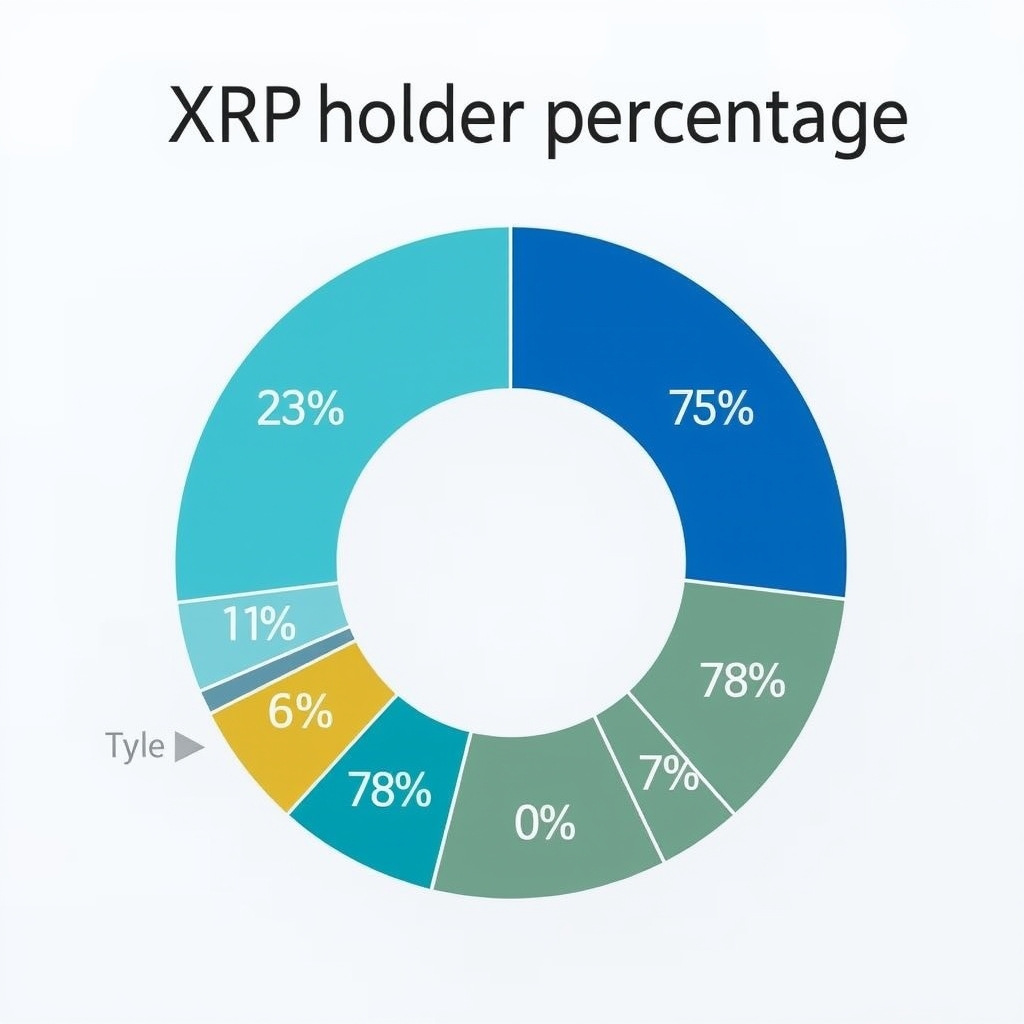
Breaking down the percentage of XRP holders into categories clarifies market power:
-Whales: top addresses holding large XRP balances (often exchanges or early investors). Their percentage of holders is small numerically but large by supply share.
-Institutions: banks, payment providers, or large custodians that accumulate XRP for liquidity or settlement; often represented by a few addresses with significant supply.
-Retail: many small addresses holding modest amounts; they represent a large share of wallet counts but a smaller share of supply.
For example, the top 100 XRP addresses might collectively hold 50–70% of the total supply, which means the percentage of XRP holders who control meaningful supply is concentrated. However, the percentage of unique retail wallets could exceed 90% of holders when counting addresses with under 1,000 XRP.
Geographical distribution and KYC's impact on holder percentages
Geographical patterns impact the percentage of XRP holders in subtle ways. Exchanges and custodians that serve certain regions can concentrate holdings in a few addresses, skewing the holder percentage by geographic origin. KYC requirements also shift on-chain patterns: when users move funds to custodial services for compliance or fiat conversion, the visible percentage of individual holders decreases as balances pool under single exchange addresses.
Moreover, regulatory actions in a jurisdiction can change behavior—local exchanges may delist or reduce XRP exposure, altering on-chain distribution and thus the percentage of XRP holders across regions. Analysts should factor in exchange flow data and KYC-driven migrations when interpreting holder percentages.
Comparison: percentage of XRP holders vs BTC and ETH
Comparing the percentage of XRP holders to Bitcoin and Ethereum helps contextualize concentration and adoption. XRP's historical escrow and distribution model often produce higher concentration among top addresses than BTC and ETH, which have had longer organic, decentralized distribution paths.
| Metric | XRP | Bitcoin (BTC) | Ethereum (ETH) |
|---|---|---|---|
| Top 10 addresses' share | ~40–65% (varies by source) | ~15–30% | ~10–25% |
| Retail wallets (>0, <1,000 balance) | High by address count; smaller by supply% | High; more even spread over time | High; many small holders via DeFi |
| Exchange concentration | Significant due to custodial pools | Significant but more diversified | Significant and spread through smart contracts |
This table is illustrative: exact percentages change frequently. The key takeaway is that the percentage of XRP holders that control supply is typically more concentrated than BTC/ETH, which has implications for price sensitivity to large-holder moves.
Trends over time: historical shifts in XRP holder percentages
Holder percentages evolve. Early years saw a small number of large holders; subsequent escrow releases and market activity increased both the number of wallets and the share of small holders. Market cycles matter: during bull runs, retail participation often spikes, raising the percentage of small holders; during downturns, consolidation into exchanges and larger addresses reduces the percentage of independent holders.
Key historical drivers include Ripple's sales program, legal and regulatory developments, exchange listings/delistings, and macro market cycles. Monitoring percentage of XRP holders over rolling windows (30/90/365 days) helps identify whether new holders are retail-driven or whether whales are increasing their share.
Why the percentage of XRP holders matters for price and governance
The distribution of holders affects market behavior in several ways:
1.Price volatility: Higher concentration (a smaller percentage of holders controlling supply) can amplify volatility if whales move funds.
2.Liquidity risk: If a handful of addresses hold a large share, selling pressure from those addresses can overwhelm available order book liquidity.
3.Network perception: A widespread percentage of small holders signals broader adoption and can improve market confidence.
4.Regulatory exposure: When a large percentage of supply sits with identifiable institutional addresses, regulatory actions targeting those entities can have outsized market impact.
Investors should therefore track the percentage of XRP holders at different balance thresholds to understand systemic risk and tail events driven by concentrated sellers or buyers.
How to analyze holder concentration: metrics and a simple table
Useful metrics for analyzing the percentage of XRP holders include: top-n supply share, number of non-zero addresses, addresses holding >1,000 XRP, Gini coefficient, and exchange custody share. Using these, you can build a snapshot of concentration versus distribution.
| Metric | What it tells you | How to use it |
|---|---|---|
| Top 10% supply share | How much supply is controlled by the largest holders | Higher values = greater concentration risk |
| Addresses with >1,000 XRP | Count of holders with economically meaningful balances | Track trend: rising count = growing meaningful adoption |
| Gini coefficient | Distribution equality measure (0 = equal, 1 = concentrated) | Compare across assets to contextualize percentage of XRP holders |
Combining these metrics gives a layered view of the percentage of XRP holders: is growth in wallet count accompanied by meaningful balance accumulation or mostly by dust wallets? Answering that clarifies whether distribution is genuinely broadening.
Practical takeaways and tools to monitor percentage of xrp holders
For investors and analysts who want to track the percentage of XRP holders in practice, these tools and practices help:
-On-chain explorers and analytics platforms (e.g., XRP Ledger explorers, Nansen-style dashboards) to view top-holder lists and historical flow.
-Exchange flow analysis to separate custodial vs non-custodial holdings and estimate true holder percentages.
-Threshold monitoring: set alerts for changes in addresses above meaningful balance cutoffs (e.g., >1,000 XRP, >10,000 XRP).
By combining automated alerts with periodic manual audits (look for new large addresses, sudden transfers from known custodian wallets, or escrow releases), you can stay informed about shifts in the percentage of XRP holders that matter for market dynamics. Understanding these dynamics improves risk management and strategic decision-making when allocating capital to XRP or building trading strategies tied to distribution changes.
FAQ
What percentage of XRP is owned by the largest wallets?
Large wallets, including exchanges and Ripple-controlled addresses, hold a substantial share of the total XRP supply. Exact percentages change over time; to get up-to-date figures use on-chain explorers (like XRPScan or Bithomp) to rank top holders and calculate their combined share of the 100 billion XRP supply.
How concentrated is XRP ownership overall?
XRP ownership is relatively concentrated compared with many decentralized tokens because Ripple initially retained a large allocation and placed much in escrow. Concentration fluctuates as Ripple releases escrowed XRP, exchanges move funds, and wallets redistribute holdings, so on-chain metrics are needed for current concentration estimates.
How can I check what percent of XRP a wallet holds?
Use an XRP blockchain explorer to look up a wallet address, view its balance, and divide that balance by the total supply (100 billion XRP) to compute the percentage. Many explorers also provide leaderboards that show the combined percentage held by the top N wallets.
Do exchange wallets count as individual holders when measuring percentage distribution?
Exchange-managed wallets often aggregate many users’ funds but appear on-chain as single large addresses, so they inflate concentration metrics if treated the same as retail wallets. For a more realistic retail distribution, some analyses try to estimate “exchange-adjusted” holdings by attributing exchange balances to many users.
How much of XRP does Ripple the company own and how does that affect percentages?
Ripple originally retained a large allocation and locked a large portion in escrow to control supply release; those holdings represent a significant percentage of circulating XRP depending on released amounts. Since Ripple’s escrow releases are public on-chain, they directly affect how concentrated supply appears at any given time.
Are XRP holders mostly individual retail users or institutions?
Both groups participate; many addresses are retail-sized, while a smaller number of institutional, exchange, and Ripple-controlled addresses hold large shares. On-chain distribution metrics show a long tail of small addresses but a concentration of value in the largest wallets.
What is a whale in the context of XRP holders, and how much do whales control?
A whale is any address (or entity) that controls a large amount of XRP relative to total supply; whales can be exchanges, institutions, or early holders. Whales often control a meaningful percentage of circulating XRP and their movements can significantly influence market dynamics.
How often does the percentage distribution of XRP holders change?
Distribution changes continuously as wallets move funds, exchanges consolidate, and Ripple releases escrowed XRP. Major shifts often occur with large transfers, exchange inflows/outflows, or institutional buys/sells, but smaller activity creates gradual distribution changes.
Why does XRP distribution matter for investors?
Concentration affects liquidity, price volatility, and potential for market manipulation: when a few addresses hold large shares, large moves by those holders can swing prices. Understanding distribution helps assess decentralization and systemic risk in supply concentration.
Can the same entity control multiple XRP wallets and skew percentage measurements?
Yes; a single entity can and often does control multiple addresses, and cluster analysis is required to estimate true entity-level concentration. Without clustering, on-chain counts may overstate the number of independent holders and misrepresent concentration.
How reliable are public metrics that claim a specific percentage of XRP holders?
Public metrics are useful but can vary by methodology (whether they count exchanges, cluster addresses, or include escrow). For the most reliable view, check the methodology behind any statistic and, if possible, use raw on-chain data to reproduce results.
Do escrow releases by Ripple change the percentage holdings of retail investors?
Yes; when escrow XRP is released and sold or transferred to exchanges, the circulating supply and distribution change, potentially diluting some percentage metrics and increasing concentration on exchange wallets temporarily. Subsequent distribution through sales or transfers can spread XRP back into smaller addresses.
How many XRP addresses hold a meaningful amount (e.g., more than 1,000 XRP)?
The count of addresses above any threshold is public and can be found via blockchain analytics; the number of addresses holding more than 1,000 XRP (or any other cutoff) gives insight into mid-sized holder prevalence. Expect thousands to tens of thousands of addresses in mid-tier bands, but exact counts vary with market conditions.
What tools can I use to analyze XRP holder percentages and distribution?
Use XRP-focused explorers (XRPScan, Bithomp), blockchain analytics platforms (Messari, Nansen with XRP support), and on-chain APIs to query balances, rank holders, and export datasets for custom analysis. Complement on-chain data with exchange reports for an exchange-adjusted view.
How does the circulating supply differ from total supply and why does that matter for percentage calculations?
Total supply refers to the total created XRP (100 billion), while circulating supply excludes XRP that is permanently destroyed or locked beyond normal circulation (though most analyses use total minus clearly non-circulating amounts). The choice affects percentage calculations—using total supply understates percentages compared to using circulating supply if a large portion is locked.
Are small holders (micro balances) significant when assessing percentage distribution?
Small holders are numerous and indicate broad adoption, but their combined share of total XRP is usually small compared to large wallets. Micro balances are important for network usage and community metrics but contribute little to supply concentration risk.
How transparent is XRP holder data compared to other blockchains?
XRP ledger is public, so balance data is transparent and auditable like many other blockchains, but identifying real-world entities behind addresses requires extra analysis and off-chain data. Transparency for on-chain balances is high; entity attribution is the harder part.
Can token burns or destruction affect XRP holder percentages?
XRP does not have a native burn mechanism that reduces total supply except for transaction fees that destroy small amounts; therefore burns have minimal impact on overall supply and holder percentages. Large permanent burns would be necessary to meaningfully alter distribution, and those are not a common feature of XRP usage.
How have historical events altered XRP holder percentages?
Major escrow releases, large exchange listings/delistings, regulatory news, or notable institutional buys/sells have historically shifted distribution by moving large amounts between wallets and exchanges. Tracking spikes in on-chain transfers around news events reveals how holder percentages reacted.
Is there a public record of the top XRP holders over time?
Yes, on-chain explorers and some analytics platforms keep historical snapshots or enable queries across block heights, allowing you to see how top holder rankings and their percentage shares changed over time. Use historical queries to analyze trends and concentration shifts.
How does airdrops or token distribution campaigns affect XRP holder percentages?
XRP itself rarely uses airdrops, but if an airdrop splits holdings into many receiving addresses, it could temporarily increase the number of small holders and reduce apparent concentration. Most distribution effects depend on whether recipients keep or consolidate their tokens afterward.
How does the percentage of XRP held by retail investors compare with institutional holdings?
Retail investors collectively hold many addresses but a smaller aggregate share than institutional-like entities (exchanges, Ripple, large OTC buyers). Accurate comparison requires classifying addresses via clustering and off-chain data to estimate institution-controlled proportions.
How do staking or lack thereof affect XRP holder percentages?
XRP does not use proof-of-stake, so there is no staking lock-up that concentrates supply; holders retain custody and can move funds freely, which tends to keep distribution more fluid than staked ecosystems where large validators hold concentrated stakes. Absence of staking reduces protocol-driven lock-ups that would otherwise affect percentages.
How important is exchange custody in understanding XRP holder percentages?
Exchange custody is critical because large exchange wallets represent many users under one address, artificially inflating concentration metrics if not adjusted. Separating exchange-held XRP from self-custodied addresses is essential for realistic distribution analysis.
How can I protect myself from risks associated with concentrated XRP holdings?
Diversify holdings across assets, avoid overexposure to a single token, use reputable exchanges and personal custody when possible, and monitor on-chain whale activity that could precede market moves. Awareness of concentration metrics helps you gauge systemic risk.
How do I interpret Gini coefficient or other inequality metrics for XRP?
The Gini coefficient quantifies inequality in ownership: values closer to 1 indicate high concentration, while values near 0 indicate even distribution. For XRP, a higher Gini suggests dominance by a few holders; use this alongside raw top-holder percentages for a fuller picture.
What legal or regulatory implications arise from concentrated XRP holdings?
Regulators may scrutinize entities with large holdings for market manipulation or transparency, and centralized holdings can expose markets to compliance actions affecting price and access. Keep informed about legal developments and how large-holder movements intersect with regulatory news.
How often should I check XRP holder percentages if I use them in investment decisions?
Check distribution metrics regularly—daily or weekly—if you actively trade, and monthly for long-term positions. Major whale movements and escrow releases can cause swift changes, so monitoring alerts from analytics tools is helpful.
Comparing XRP holder percentages with Bitcoin: how do they differ in concentration?
Bitcoin tends to have a broader base of individual holders and decentralized mining-associated distribution, while XRP has historically been more concentrated due to Ripple’s retained allocation and escrow. Both networks have large holders, but XRP’s corporate allocation increases apparent concentration.
Comparing XRP holder percentages with Ethereum: which is more distributed?
Ethereum’s distribution is influenced by many smart contract addresses, DeFi protocols, and wide developer participation, often resulting in a different concentration profile than XRP. Ethereum typically shows broad holder diversity through many contract and user addresses, though large addresses still hold significant ETH.
How does XRP holder concentration compare with stablecoins like USDT or USDC?
Stablecoins are often highly concentrated because a few issuers and large market-making entities hold big balances to manage liquidity; similarly, XRP can show high concentration when large exchange or Ripple wallets dominate. Both require exchange-adjusted analysis to understand retail exposure.
Comparing XRP with newer altcoins: do small-cap tokens tend to be more concentrated than XRP?
Many small-cap tokens are extremely concentrated due to early team allocations and small liquidity pools, often more so than XRP. While XRP has notable concentration, legacy tokenomics and escrow practices can make it less concentrated than some tiny altcoins but more than large decentralized assets.
How does XRP holder distribution compare to traditional asset holdings like company stock?
Company stock holdings can be highly concentrated among insiders and institutional investors, similar to XRP’s concentration among corporate and exchange wallets. However, securities are regulated with disclosure requirements, whereas on-chain token holdings are transparent but lack the same legal disclosure structure.
Comparing XRP holders to gold holders: which is more centralized?
Gold ownership is distributed globally across retail, institutional vaults, and central banks, and while large reserves exist, the on-chain transparency of XRP makes concentration easier to measure. Gold may be less transparent but often more widely distributed in physical form than digital token holdings like XRP.
How does XRP holder concentration relate to exchange-traded funds (ETFs) for crypto?
Crypto ETFs aggregate investor exposure in institutional funds, concentrating ownership in ETF custodial addresses; XRP has concentration in Ripple and exchange wallets, so the effect is similar: a single trust or custodian can represent many investors, increasing on-chain concentration patterns.
Comparing XRP with fiat bank deposits: are XRP holder percentages more or less concentrated?
Bank deposits are concentrated in large institutions and corporate accounts but are off-chain and not publicly visible; XRP provides transparent on-chain concentration that can appear higher because major custodians and exchanges hold large visible balances. The observable concentration in XRP is often clearer than in banking.
How does the percentage of XRP held by exchanges compare with other cryptocurrencies?
Exchanges typically hold large portions of circulating supply across many cryptocurrencies; for XRP, exchange-held percentages can be significant and sometimes higher than more decentralized coins with many self-custodied wallets. The precise share varies by ecosystem and market maturity.
Comparing XRP whales to Bitcoin whales: which group has more market-moving power?
Both XRP and Bitcoin whales can move markets, but Ripple-controlled holdings and escrow mechanics can add additional supply-side levers in XRP’s case. The market-moving power depends on liquidity; in thinner XRP markets, whales may have greater short-term impact.
How do institutional custody solutions affect XRP holder percentages versus other tokens?
Institutional custody aggregates client assets into large custodial addresses, increasing on-chain concentration for any token, including XRP. Tokens with strong institutional uptake will show more of their supply in custody solutions compared to those dominated by retail self-custody.
Comparing XRP distribution to ERC-20 tokens used in DeFi: what’s different?
ERC-20 tokens used in DeFi often fragment holdings across many smart contracts (liquidity pools, staking contracts), which can create an appearance of broader distribution even if underlying LPs belong to a few actors. XRP lacks the same smart-contract ecosystem, so its distribution centers more on individual and custodial wallets.
How does XRP’s percentage held by developers or founders compare with new crypto projects?
New projects often reserve large founder allocations that can be highly concentrated; Ripple’s early retention of XRP mirrors that pattern, though Ripple’s escrow mechanism was intended to manage releases over time. The risk of concentration is similar, but legacy governance and corporate use-cases differ.
Comparing XRP percentages to central bank reserves: are they analogous?
Central bank reserves concentrate national holdings of fiat and assets; while conceptually similar in concentration, XRP’s on-chain transparency and private corporate control differ from sovereign reserve structures. Both show how concentrated control can influence broader markets.
How does XRP holder concentration compare to tokenized assets like blockchain-based stocks?
Tokenized assets often reflect centralized issuance and custodial concentration, similar to XRP’s corporate holdings and exchange custody. On-chain concentration is common when a centralized issuer or custodian controls large supplies.
Comparing the percent of XRP holders with user base percentages in payment networks (like SWIFT): what’s the difference?
Payment networks like SWIFT don’t expose individual account balances on a public ledger, so concentration is opaque, whereas XRP’s ledger makes holder distribution visible. XRP’s concentration is measurable and can be compared to estimated participant concentration in payment networks, though the systems serve different purposes.
How does the percentage of XRP held by long-term holders compare with that in speculative altcoins?
XRP has a notable cohort of long-term holders including institutions and early adopters, while many speculative altcoins see higher short-term trading and turnover. Long-term holdings tend to stabilize distribution, whereas speculative tokens often show rapid changes in holder percentages.